


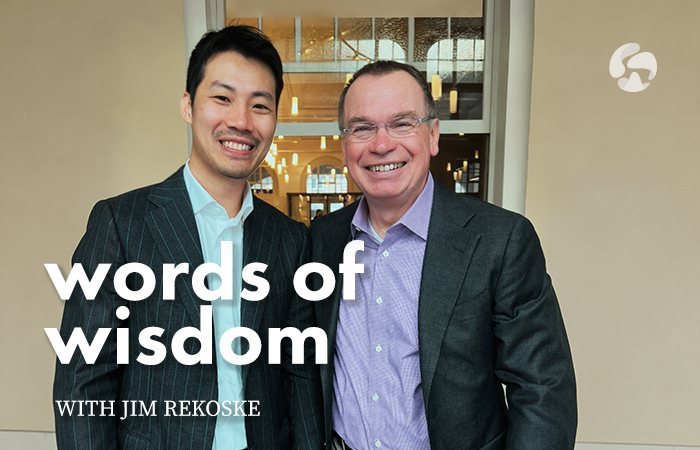
As water scarcity, industrial sustainability, and resource efficiency become increasingly urgent global priorities, the role of innovation in water technology has never been more important. In this conversation, Kelven Lam, Investment Director at Emerald, speaks with Jim Rekoske, a veteran executive who has held leadership roles across Honeywell and Ecolab, spanning both business and technology functions. Drawing on decades of experience working across industrial and institutional markets, Jim shares his perspectives on water reuse, innovation cycles, startup partnerships, and what corporates truly look for when engaging emerging technology companies.
Kelven Lam:
You've held both business and technology leadership roles at Honeywell and Ecolab, working across heavy industries and institutional markets. From your experience, where do you see water becoming an increasingly important strategic priority, and what's driving that shift?
Jim Rekoske:
In two real important areas for us, I think, as a society. So number one, we use a lot of water in our daily lives that we don't recognize. So, just a typical one night hotel stay, you use 300 gallons of water per person. And number two, in all of the products which we buy, whether it's electronics, or paper, or anything plastic, there's a tremendous amount of water used in producing those.
The challenge with all of that water is, can be reused? It is not the product. It is used for a purpose. So in the hotel, it's used to clean laundry. But the water can be separated from the soil and reused very effectively.
And so I think in two areas for us, we need to get much, much better at reuse and reuse technologies. And second of all, we need to get better at being able to identify where we can cost effectively change processes to be able to utilize water differently in a manner which is more efficient.
Kelven Lam:
So on the reuse side of things, what type of innovations do you see that are particularly exciting in addressing the challenge?
Jim Rekoske:
One of the things that's interesting to me, is today we could recycle every drop of water we use from just about every way we use it. It's just a matter of how much it costs to do that.
So, as you know, we could go and grab the world's greatest RO membranes, and we could run RO, we could run many other different processes on that water in order to be able to get back very, very high quantity of molecules back again. Problem is just the cost.
And so for me, all of those reuse technologies, we just need to figure out a way to reduce the costs substantially in order to be able to get the economic benefit to equate with the societal benefit.
And right now, two ways to do that: the price of water can go up or the cost of the technologies can go down. And I would prefer to see the cost of the technologies go down.
Kelven Lam:
And going back to what you just raised about membranes, and the reuse side of things – many of the technologies that we see are quite hardware driven. So in your experience, do you see any trends based on these hardware-centric approaches that should help lower costs or improve performance?
Jim Rekoske:
One thing that's really interesting to me over my career has been the pace of innovation and how innovation pace has changed.
So 30, 35 years ago when I started working in innovation, it would be not uncommon for a physical innovation product — an offering, an industrial offering, an industrial technology — that could take years, four, five, 6 years to develop and get into the marketplace.
And now, because of the pace at which things are happening and changing in the world, we're now seeing cycle times in innovations drop to one year or, in some industries, software, as you know, is daily sometimes with cycles of innovation.
And so, the challenge for our industries, particularly when it comes to water, is to figure out how to compress those cycles of innovation in order to be able to get out faster with good prototypes, show what can work, and then kind of continue the trajectory of pace, because it does take far too long to really launch a new physical product today. And that needs to really reduce.
One of the things that I'm excited by is how software interacts with physical products, both in the design stage and in the implementation stage, because both of those stages can be significantly reduced with using the right software combined with the hardware products.
Kelven Lam:
That’s a good point. And then transitioning towards partnerships and how corporates assess startups. I know corporates look at them differently depending on the decision point, but it would still be good to get a window into how, during your time at Ecolab, you decided whether or not to engage with an emerging water technology.
What were the decision triggers around whether to invest early through a minority stake, pursue a commercial partnership, or wait and acquire later?
Jim Rekoske:
The rubric that most people use in deciding those questions or that path forward is really along the lines of: how comfortable am I with the base technology? And how comfortable am I with the adjacent technologies?
So if this is an incremental improvement over something which the company knows quite well, oftentimes they will say, well, I'm either gonna just do this myself, or I'm gonna wait until this company has proven its traction to be substantial, and then I'll just go ahead and buy it, because I'm not only buying the innovation, but I'm buying business as well at that point.
So incremental changes oftentimes end up being more of a purchase decision. Sometimes they can be partnership opportunities because there's channel that you can bring as a larger enterprise. There might be reasons why you don't necessarily want to jump in with your brand on that component immediately.
So, I would say incremental technologies lean towards partnership or wait-and-acquire.
It's the breakthrough technologies — because companies only have so much bandwidth. And we're pretty good at doing incremental things. We're generally forced to look at things on a quarter-by-quarter or year-by-year basis, which drives people to think incrementally.
And so what we're not good at is what could eat our lunch, so to say, what could transform our technology. And that's where we generally look to really find strong partnerships, for sure, or invest in the technology because we need to learn, especially if it's a technology area we don't really know well.
Investment is usually the best course, because that's the easiest way for you to learn.
Oftentimes, Kelven, the only thing you have to bring to the company is your name and your money. And the combination of those two things is valuable for you if you want to learn.
But if the company is a small company or the small enterprise is counting on you for a channel, then you need to work with them to develop that channel, because you don't have an offering there.
Kelven Lam:
Beyond the core technology or product itself, what are the less obvious signals that you look out for that give you confidence a company is ready for serious engagement with a corporate?
Jim Rekoske:
So, from a “ready for serious engagement” standpoint, the usual trigger that I look for, whether it's a hardware product or a software product, is what stage of prototyping are they in?
Are we looking at conceptual drawings? Are we talking about a pilot plant which looks like it has been cobbled together by a second-year graduate student? Or is it professionally designed, professionally implemented?
And I think you'll remember one of my comments when I first visited Water and Carbon Group, was exactly that – that the professionalism with which they implemented their first commercial offering was exceptional for a company of their scale.
So that's what I look for on the physical and digital side: what does the prototype or first offering look like?
The second thing I think that's kind of obvious, but it's not talked about enough, is the people.
We tend, as corporates, to want to associate with people who we trust, and a big part of that trust is oftentimes balancing the need to be bold in your statements as a startup to attract interest, but conservative enough in order to really hit your targets.
So for me, it's finding the people who know that and understand that — that it's not just about always selling the upside. It's got to also involve talking about the risks.
And people who really understand that are the critical ones, in my view, for interacting with large companies.
Kelven Lam:
It’s good that you mentioned Water and Carbon Group. Could you share another example of a partnership in the water or water-adjacent markets that turned out really well, and why it was such a good strategic fit for Ecolab?
Jim Rekoske:
There have been a few.
I think probably the most interesting one for me has been not necessarily solely directed at water but used first in water. And that was a company that we worked with called Guidewheel, which has sensor technology for measuring amp draw from motors.
So, you can imagine, if you are an operator of a cooling tower or an operator of a boiler, it's nice to know how things are operating. Are they operating as efficiently as one would want? Are the fans running the way they need to?
And building a whole connection into a distributed control system is just too expensive, right?
But if you can clamp on an $8 meter and connect it up quickly to a piece of equipment to measure it, and you can get real-time information on how the fans are operating, when they're operating — and you could do that quickly and cheaply — then there's a lot of benefit.
And we were able to do that and demonstrate that product offering with Guidewheel. And it led to deployment across a couple of different sites for manufacturing at Ecolab, which has now led to commercial partnership with Guidewheel that the team is carrying forward.
Kelven Lam:
Would this be considered more incremental or truly breakthrough?
Jim Rekoske:
It's a bit breakthrough, because while it sounds incremental in the fact that we're measuring power, the breakthrough is an $8 meter that can be wired up and connected to your system in less than an hour.
You can get literally multiple connection points lined up in a couple of hours, which is very significant.
So that was the real breakthrough — the time to install and the cost of the equipment.
Kelven Lam:
Of course, on the flip side, many corporate-startup partnerships don't fulfill their promise or lose momentum over time. Not just for water founders, but tech founders in general: what should they be most mindful of early on when discussing partnerships with corporates?
Jim Rekoske:
One of the most important things that can be done, which isn't often done from the small company side, is to ask the corporate: how are you going to measure success? What does success look like for you?
I think there's a lot of that taken for granted, and honestly, asking that question and being focused on that shows an interest in making sure that the arrangement is mutually beneficial.
One of the things I always would make sure to end with is, “Kelven, one of the things I want you to ask me is, what does success look like from our perspective, from the company's perspective?”
Because that's very important for you to keep in mind, because it's gonna guide how I view how we should be making decisions as the corporate sponsor, as the champion within the company.
And so, that's one aspect.
I think a second aspect is: don't have all your eggs in one basket.
Oftentimes, you find one champion and one champion alone. And people change jobs, people move. And that's a risky proposition.
So it's really fine to have one champion who is leading your efforts, but you should have multiple points of entry and multiple champions in the company because there are always changes in corporate enterprises.
I think we heard just this morning one of the key things is to stay in touch with the corporate venture team which brought you in. Because generally those people don't change over as frequently as the business teams do.
And so they can help with the opportunity to stay connected to the business.
Kelven Lam:
Now you're on the other side of the table advising a lot of emerging technology companies in their engagement with corporates.
What do you think founders most often misunderstand about working with strategic partners? And what would you urge them to understand much earlier?
Jim Rekoske:
The word “strategic partner” is, I think, the key phrase that needs to be remembered.
When you bring on a strategic partner, you're bringing on somebody who's going to have goals which are different from the goals of the other people who have been funding your enterprise.
Most, if not all, venture partnerships with strategic partners have a component of scouting, a component of learning, a component of bringing in new business opportunities to the company.
And the financial return, while important, isn't at the top of the list.
Whereas for the majority of other venture capital money which will come in, the top of the list is the financial return.
So as a result, you will have to manage that difference of opinion.
And oftentimes the difference of opinion shows up in pace, in how ready the product is, and you need to be prepared as a founder or as a leader of that company to manage those differing expectations at the board level.
More on Water at Emerald:
Emerald Global Water Fund II reaches €100 million with addition of Temasek and Grundfos Foundation