


An Electric European Venture Fair
After 25 years of bringing investors, industrial leaders and founders together, the European Venture Fair 2026 centered on the commodity on which almost every industrial ambition now depends.
Twenty-five years is a long time in venture capital. Funds close, strategies pivot and fashionable technologies become cautionary case studies with surprising speed. The European Venture Fair, conceived by Emerald’s Gina Domanig, was built from scratch as an ecosystem of peer investors who, only together, could foster important global innovations. A well-functioning ecosystem like this – that brings together the people who decide which industrial technologies are financed, bought and scaled – is priceless. And it’s enduring success speaks for itself.
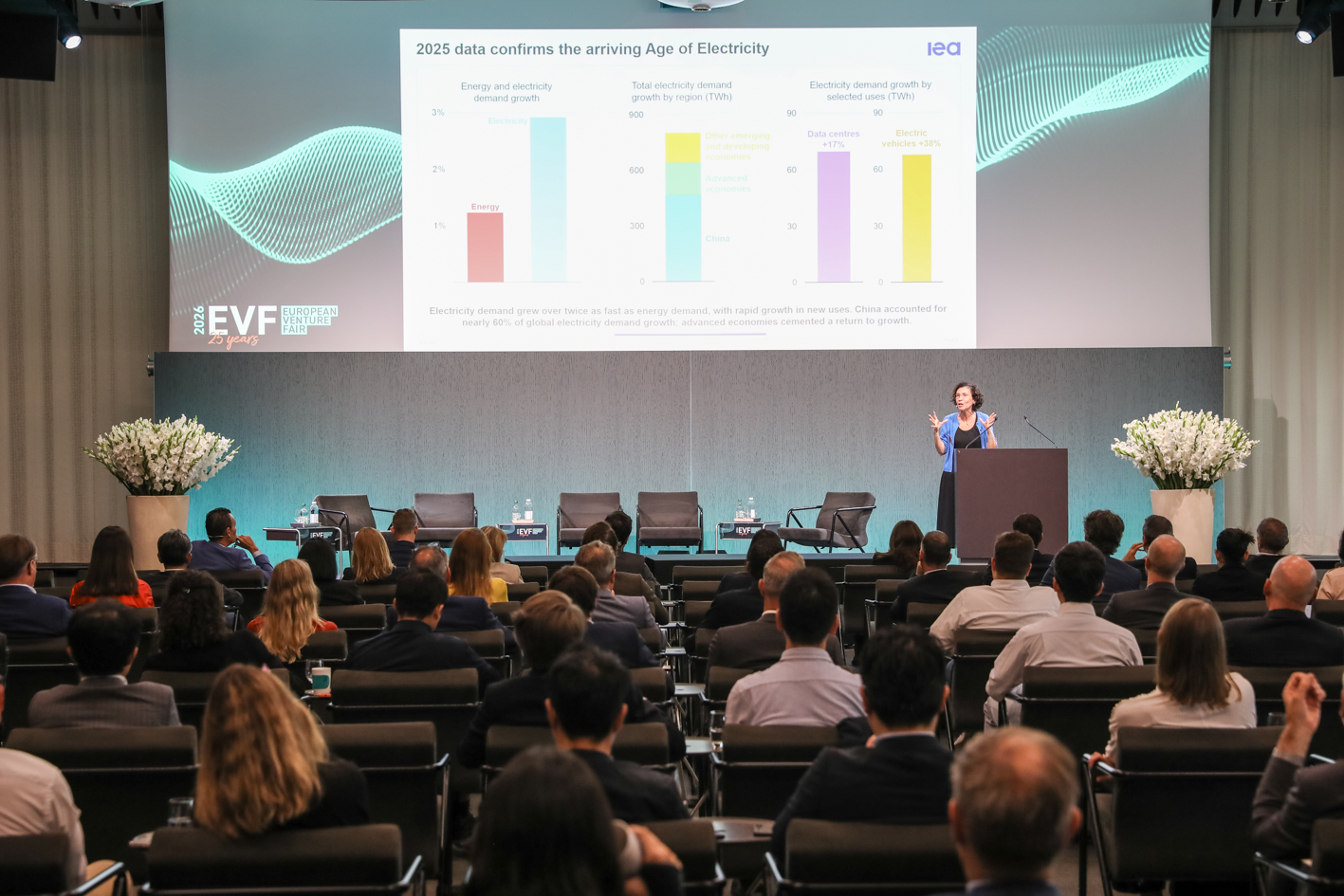
At the 25th edition in Zurich, electricity kept turning up. It powered the opening keynotes, framed the final panel and ran through many of the startup presentations. The atmosphere was celebratory; the argument was sober. Abundant computing, industrial resilience, national security and the next stage of decarbonization all depend on a power system that cannot be expanded at software speed.
The anniversary was marked with a sunset boat ride to Rapperswil Castle. After a day spent worrying about electrical currents, delegates were happy to entrust themselves to the currents of Lake Zurich.
The return of the electricity problem
Taken together, the opening sessions offered a useful synthesis. Clean energy continues to expand faster than many earlier forecasts suggested. Battery prices have fallen by roughly 95% in a decade. Electric vehicles accounted for about a quarter of global car sales last year, while sales of internal-combustion cars have fallen by more than a third from their 2017 peak. Repeated fossil-fuel shocks strengthen the economic case for technologies that reduce exposure to volatile commodities.
That does not mean fossil fuels vanish on schedule. The latest disruption in the Gulf has prompted renewed interest in domestic oil and gas, while natural gas remains one of the quickest sources of firm power available to some data-center developers. Yet new hydrocarbon projects take years. Wind, solar and batteries can usually be built faster. Energy security and decarbonization, once rather disconnected, are now reinforcing one another and are increasingly pointing towards some of the same investments.
The larger change is the return of electricity-demand growth after years of stagnation in many advanced economies. Electrification of transport, heating and industry is one cause. Cooling in emerging economies is another. AI is the most dramatic, though also the easiest to exaggerate. Data-center developers have placed enormous projects in grid-connection queues, but a queue is not a demand forecast. Some proposals will secure land, power and customers; many will not. Investors must learn to tell the difference.
Two clocks and one grid
The technology sector and the energy system operate on different clocks. AI companies plan in months and want electricity now. Grids, power stations and permitting systems work in years. The result is a collision between digital urgency and physical infrastructure. A model can be retrained overnight; a transmission line, however, cannot be built overnight.
The scale of AI demand remains contested. One view presented at EVF held that US electricity consumption from AI could, within five years, rival the country's existing energy-intensive industries. A more skeptical view noted that only a fraction of the terawatt-scale projects in connection queues will survive contact with economics. Both arguments lead to the same conclusion. Power availability, rather than processing ambition, may set the pace of deployment.
Electricity also brings new dependencies. Energy security once meant access to oil and gas. It now includes grids, batteries, power electronics, critical minerals and the factories that make them. Half of the energy patents tracked by the International Energy Agency in 2025 related to batteries and storage. The concentration reflects technical progress, but also the search for chemistries that rely less on vulnerable supply chains.
Not every electron is equal
Electrification can reduce fossil-fuel imports, improve efficiency and cut emissions. It can also consume startling quantities of power. Electrifying Europe's existing industrial processes without regard to economics or location would overwhelm the system long before it completed the transition. Electrons are useful. They are also scarce in the places and timeframes that matter.
The Electricity Ladder discussed at EVF offered a way to choose. Each application should be judged by four factors: cost, carbon, economic value and water. A process that works with cheap, abundant low-carbon electricity may fail in a region where industrial power is expensive or water is scarce. Some uses should be accelerated; others should wait for better technology, lower prices or be moved to a more sensible geography.
This makes electricity a strategic asset rather than another line in the operating budget. The useful investment question is no longer simply whether a process can be electrified. It is whether it should be electrified here and now.
Flexibility becomes infrastructure
New generation is politically photogenic. Flexibility is less so, but it may be just as valuable. The final plenary session examined how millions of connected assets can respond to grid conditions instead of merely consuming electricity. In Britain, Kraken aggregates roughly 600,000 household devices into a virtual power plant of around 2 to 2.5 gigawatts. Electric vehicles, heat pumps and batteries can then be coordinated with utilities and system operators.
Such software cannot manufacture electrons, but it can extract more capacity and resilience from assets already attached to the system. That matters when a grid connection is the slowest part of a project. It can also create a formidable data advantage. Kraken Flex processes some 20 billion readings a day, a scale that is harder to reproduce than another optimization algorithm.
The start-ups behind the socket
The startup presentations showed how broad the opportunity has become. Apheros is tackling the heat produced by denser AI chips with metal-foam cold plates. GA Drilling is reducing the cost of reaching deep geothermal resources. Holyvolt combines automated experimentation with AI to discover battery materials, while Qurrent connects batteries and renewable assets to energy markets. Renaissance Fusion is building high-temperature superconductors and other industrial foundations that future fusion machines will need. Membion approaches the problem from the demand side, with wastewater technology designed to cut the energy used in membrane aeration by up to 90%. Other founders pitched technologies for autonomous inspection, more efficient concrete, wastewater treatment, bio-based colorants’ and plastic recycling.
The human network
The rest of the program widened the view. One plenary session asked what fusion must prove on the path from plasma to commercial power. Another examined where Physical AI is moving from entertaining demonstrations into industrial work. A roundtable considered how AI is changing venture-capital best practice.
The most important part of this event, however, has remained the same for 25 years. While algorithms can screen companies and video calls can fill calendars, neither creates much trust among the people who control capital, industrial assets and policy. Their choices determine what gets built. For all the talk of artificial intelligence, the most useful technology at EVF may still have been the table: it enables people with influence to spend time together.
That is reason enough to keep meeting. The future will be shaped by people with influence who choose to spend time together and act on what they learn. If you help decide what industry builds next, join us for the 26th European Venture Fair on 8-9 September 2027 at the Swiss Re Centre for Global Dialogue in Rüschlikon. Register your interest.
More on energy at Emerald:
Cummins Joins Emerald to Advance Customer-Focused Innovation Across Power, Mobility and Energy
Emerald joins $100M Series B Funding in Thea Energy to Build Scalable Fusion Power Plants
Accelerating Action: Barbara Burger shares CVC leadership lessons in energy