


 By Fredric Petit, Partner, Emerald
The printing industry likes to think of itself as mature: a world of incremental efficiencies, calibrated machinery and steady industrial demand. Yet the latest Emerald Sprint on Printing Technologies painted a very different picture. Participants (including raw material producers, adhesive material and ingredients suppliers, convertors, manufacturers of coding, marking and printing technologies, brand owners from the cosmetic, personal care and food & beverage sector, and global leaders in recycling and waste management) argued, that packaging print is quietly becoming one of the most strategically contested layers of the consumer economy – not because consumers suddenly care about printing itself, but because nearly every pressure now bearing down on modern supply chains eventually lands on packaging.
What emerged from the discussions was not a story about prettier labels or faster presses. It was a story about industrial systems under strain. Sustainability mandates, SKU proliferation, labor shortages, volatile demand patterns and the digitization of commerce are converging to force a reinvention of how packaging is produced, personalized and recycled.
Flexible Production is a Must
Several themes surfaced repeatedly. The first was flexibility. Brand owners increasingly operate in a world of fragmented consumer demand: more flavors, more formats, more limited editions, more localization. Industry research presented during the Sprint showed that 61% of brands had already increased their number of SKUs over the past two years, while 75% expect further expansion ahead. At the same time, shorter run lengths are becoming normalized, with over half of packaging printers reporting growing demand for short production runs.
This has profound consequences for manufacturing economics. Traditional analogue printing systems excel at long, stable production runs. But modern consumer markets increasingly reward responsiveness over scale efficiency. Faster turnaround times are now considered essential by most packaging buyers, and digital printing is valued not merely for aesthetics but for its ability to reduce inventory, enable test marketing and support rapid product iteration.
The result is the rise of the “hybrid factory”: production environments where digital and analogue printing coexist rather than compete. Multiple speakers described hybridization not as a future possibility but as the emerging industry standard. Conventional high-volume technologies still dominate overall output, particularly in flexible packaging and corrugated applications, but digital systems are expanding rapidly into areas where adaptability matters more than pure throughput.
The Need for “Printing without Printing”
Yet if flexibility is the commercial driver, sustainability is the political and operational constraint.
The Sprint repeatedly returned to an uncomfortable reality: printing itself has become a recycling problem. Inks, coatings, labels and adhesives frequently undermine recyclability, contaminate material streams and reduce recovery yields. What once functioned as purely decorative or informational layers are now being reassessed as liabilities within circular packaging systems.
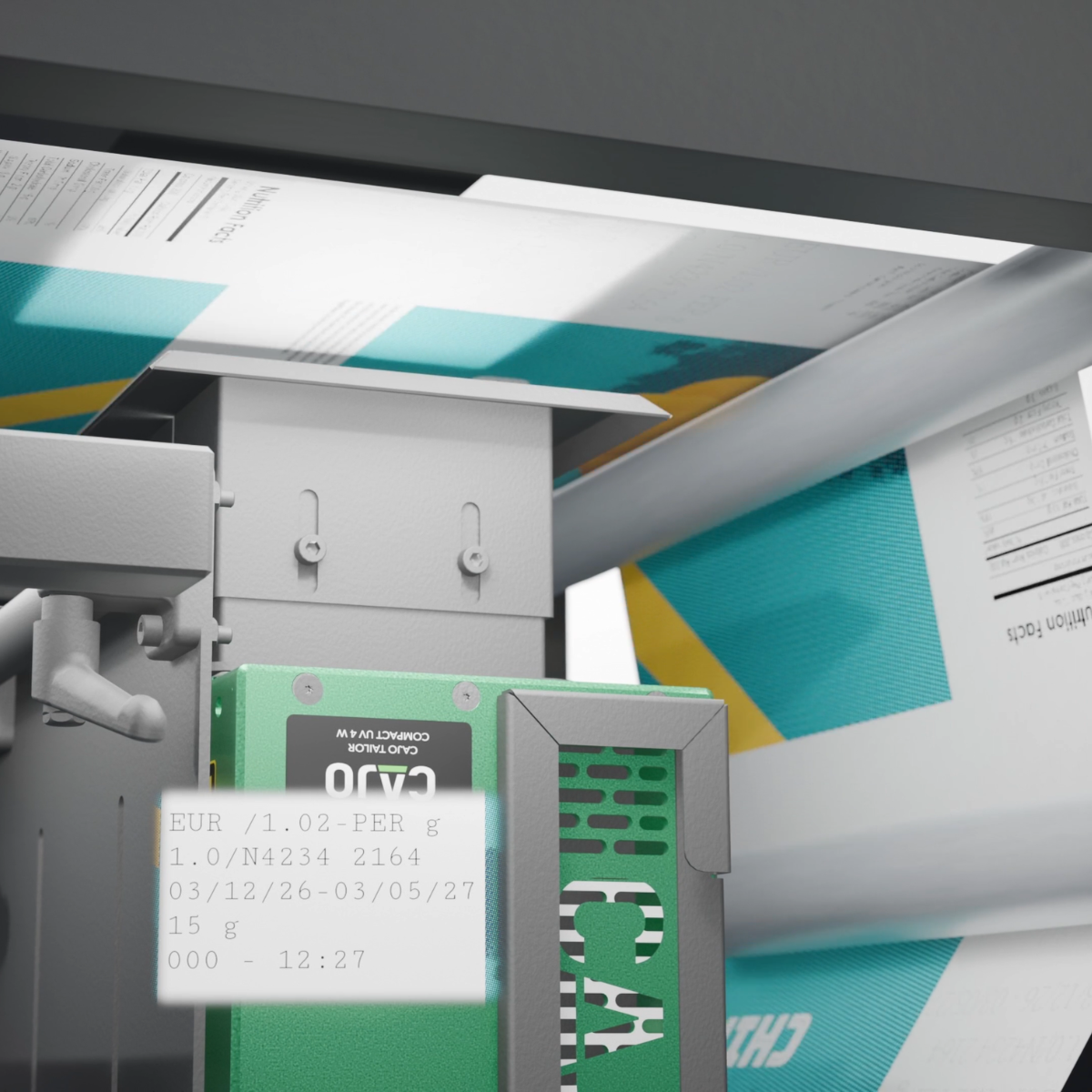
This has created intense interest in “printing without printing”. One of the most discussed technology directions involved laser-based marking systems that eliminate inks entirely by modifying the surface of the substrate itself. The appeal is obvious: remove consumables, simplify recycling and reduce process complexity simultaneously. Several participants saw direct marking technologies as especially attractive for fiber-based and mono-material packaging systems, where maintaining recyclability is paramount.
Equally important was the growing focus on late-stage customization. Manufacturers increasingly want packaging to remain generic until the latest possible moment in the supply chain, allowing products to be localised, serialized or personalised close to final distribution. But implementing such systems at industrial speed remains extraordinarily difficult. Participants repeatedly highlighted the challenge of combining high-speed variable-data printing with food safety requirements, operational reliability and compatibility across inconsistent substrates.
Key Challenges for Adopting New Printing Technologies
In many ways, the most revealing insight from the Sprint was that the industry’s core problems are no longer technological in the traditional sense. As one discussion framed it, the market demand already exists; the bottlenecks are operational.
This distinction matters. Printing technologies themselves are advancing rapidly. High-viscosity inkjet systems, direct-to-shape printing, digitally controlled coatings, AI-assisted formulation tools and advanced quality-control software are all progressing quickly. The constraint is integrating these capabilities into highly automated, heavily regulated, globally distributed manufacturing systems that cannot tolerate downtime. Several corporations described workflow integration, substrate variability and data management, not print quality, as the true barriers to adoption.
Labor shortages intensify the problem. Industry data presented during the Sprint showed persistent staffing gaps and an ageing technical workforce across packaging operations. This is helping accelerate automation, machine learning and remote diagnostics within printing systems. Increasingly, presses are expected not only to print, but also to self-monitor, self-correct and integrate seamlessly with digital production environments.
Another notable shift was the broadening role of packaging itself. Packaging is no longer merely a container or brand surface; it is becoming a digital interface. Discussions around serialization, anti-counterfeit functionality, traceability and consumer engagement suggested that packaging may increasingly operate as a data carrier within broader connected supply chains. Dynamic QR systems, digital product passports and interactive authentication layers were all discussed as future growth areas, although participants acknowledged that scalable implementation remains technically immature.
The startups showcased during the Sprint (such as Cajo Technologies) reflected this wider transition. Some focused on hardware innovation: direct-to-shape digital printing, laser marking and precision coating systems. Others targeted the invisible infrastructure around printing: AI-driven formulation tools, printhead optimization, quality inspection and traceability software. The most compelling companies were not simply improving print quality; they were attempting to remove friction from the industrial system surrounding print itself.
A subtle but important shift also emerged in business models. Several younger companies are moving away from selling standalone machinery and towards “printing-as-a-service” models, embedding digital print capability directly at customer sites while managing operations remotely. This reflects a recognition that many manufacturers do not want additional process complexity; they want outcomes without operational burden.
The New Era of Packaging Print
Taken together, the discussions suggested that packaging print is entering a transitional era similar to what manufacturing automation experienced a decade earlier. The future competitive advantage will not belong solely to the companies with the fastest presses or the brightest colors. It will belong to those capable of combining sustainability, data integration, operational flexibility and industrial scalability into a coherent production architecture.
---
More on Materials at Emerald:
Sprints: toward Sustainable Packaging
Sprints: Sorting through a flurry of new recycling technologies