



From grid capacity and battery trading to wind, fusion, and synthetic fuels, Emerald's portfolio companies illustrate the thinking behind Emerald’s electrification investments. (Above: Christoph Frei, Partner and Head of Energy, moderating an energy panel at the European Venture Fair)
Electrification is a core priority in Emerald Technology Ventures’ energy investing. That means backing the technologies that make electricity more available, reliable and useful across the economy: strengthening grids, improving generation, rewarding flexibility and extending renewable power into applications that are difficult to electrify directly.
A company can order electric equipment long before the power system is ready to supply it. That gap between industrial ambition and electrical capacity is becoming an investment opportunity in its own right.
The International Energy Agency’s Electricity 2026 report forecasts average annual electricity demand growth of 3.6% through 2030. Yet more than 2,500 gigawatts of renewable generation, storage and large electricity-consuming projects are waiting in grid connection queues worldwide. For businesses, electricity increasingly determines how quickly they can expand.
Emerald’s recent investment in Switched Source brings that challenge into sharp focus.
How Switched Source helps unlock grid capacity
Switched Source helps utilities serve more demand using the distribution infrastructure they already have. Emerald participated in the company’s funding round of more than $17 million, announced in October 2026, to support wider deployment of its Phase-EQ technology.
The problem is easy to overlook. Distribution circuits carry electricity across three phases, but demand is not always evenly shared between them. One phase can approach its operating limit while others retain spare capacity. Electric vehicle charging, heat pumps and rooftop solar can make those imbalances change throughout the day.
Switched Source’s Phase-EQ uses power electronics to redistribute power between phases automatically. Where imbalance is the constraint, this allows utilities to make better use of existing lines and equipment. Think of redistributing traffic across three lanes before deciding that the road needs widening.
In its October announcement, Switched Source reported 10–25% increases in load-serving capacity in active deployments, alongside more than 150,000 operating hours across twelve utilities. It reported typical lead times of 14–20 weeks from purchase order to activation, compared with one to three years for many conventional distribution upgrades. These are company-reported deployment results; the benefit at any particular site depends on its constraints.
The investment logic reaches beyond a single device. Electrification needs solutions that fit existing infrastructure, respect utilities’ reliability requirements and deliver useful capacity on a timetable their customers can work with.
How Emerald’s energy portfolio supports electrification
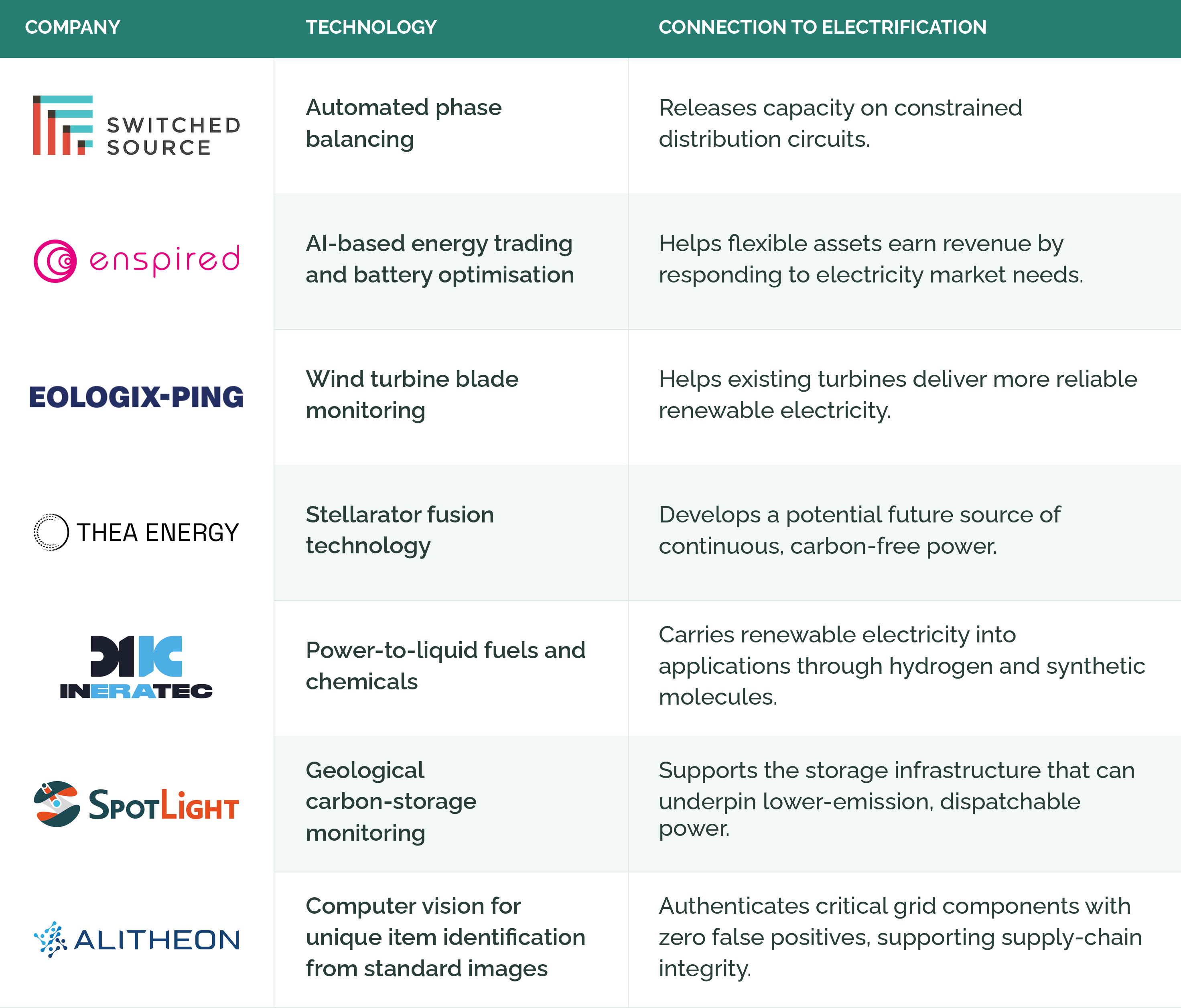
Switched Source addresses one part of a connected system. The following six portfolio companies show how broadly the electrification opportunity extends.
enspired makes electricity flexibility commercially useful
enspired helps battery owners and operators earn revenue from responding to changing electricity supply and demand. Its AI-based trading and optimisation services operate across electricity markets, helping determine when an asset should charge, discharge or make capacity available for grid services.
That commercial layer matters. A battery’s physical ability to store electricity must translate into a workable business case. Better optimisation can improve the economics of assets that help power systems accommodate variable wind and solar generation.
The practical relevance is visible in enspired’s partnership with Veolia’s Flexcity, covering battery optimisation in Belgium and the Netherlands across wholesale markets, balancing services and congestion management. Electrification creates demand for flexibility; enspired helps turn that need into a service asset owners can sell.
eologix helps wind turbines produce more useful electricity
eologix, now EOLOGIX-PING, improves the visibility operators have into the condition of their wind turbine blades. Its monitoring systems detect problems including icing, surface damage and lightning strikes, supporting maintenance decisions and turbine operation.
The connection to electrification is immediate. Installed generating capacity only helps if it produces electricity reliably. Earlier detection of blade problems can reduce avoidable downtime, while ice monitoring supports decisions about when turbines can safely stop and restart.
For a corporate electricity buyer, the distinction between nameplate capacity and dependable output matters. Technologies that improve the performance of existing renewable assets deserve attention alongside technologies that build new ones.
Thea Energy develops power for a more electrified future
Thea Energy is developing fusion technology intended to provide continuous, carbon-free electricity. Its stellarator design uses arrays of simpler, software-controlled magnets to address the manufacturing complexity associated with conventional stellarator coils.
In September 2026, Thea announced sixteen peer-reviewed papers describing its Helios power plant design. Helios is designed to deliver approximately 400 megawatts of electricity to the grid.
This is a longer-term investment in future supply: commercial electricity production remains ahead. Its relevance lies in the scale of the underlying need. An economy increasingly dependent on electricity will need additional sources of power that can operate continuously, alongside renewables, storage and stronger networks.
INERATEC extends renewable electricity into fuels and chemicals
INERATEC connects electrification to sectors where directly replacing combustion with electric equipment is difficult. Its modular reactors convert hydrogen and carbon dioxide into synthetic fuels and chemical products.
When the hydrogen is produced through electrolysis using renewable electricity, that electricity becomes an input to liquid fuels, including synthetic aviation fuel. This is often called indirect electrification: electrical energy reaches the end user through a molecule.
For long-distance aviation, that offers a route to use renewable energy while retaining the energy density of liquid fuel. The economics remain closely tied to the cost of electricity and hydrogen. Conversion losses also make the choice of application important. The strategic opportunity is to extend renewable electricity into uses where direct electrification faces substantial practical limits.
SpotLight supports the carbon infrastructure behind lower-emission power
SpotLight’s connection to electricity is indirect, through the monitoring needed for geological carbon storage. Its focused seismic technology helps operators detect subsurface changes and assess whether stored CO₂ is behaving as expected.
That becomes relevant to electricity where power generation is paired with carbon capture and storage. The IEA identifies a role for such plants in providing dispatchable power and flexibility alongside variable renewables.
In systems pursuing that route, credible storage monitoring forms part of the infrastructure needed to deliver lower-emission electricity. SpotLight’s wider industrial applications also reflect a practical reality: an electrification strategy must sit within a broader plan for reducing emissions.
Why deal flow matters for corporate electrification
These six companies show where Emerald has invested. For a corporate pursuing electrification, access to the wider startup pipeline behind those investments can be even more valuable. The technology that solves a particular business problem may sit outside the portfolio.
Emerald’s deal flow spans more than 2,000 opportunities a year across its investment sectors. That creates a much broader field of potential suppliers, development partners and investment opportunities than the companies in which we ultimately invest. A startup can be the right partner for a corporate’s electrification plans even when it does not fit Emerald’s investment criteria, timing or portfolio.
Through Innspire, Emerald’s deal management platform, participating corporate investors can explore startup evaluations and follow opportunities beyond our portfolio. For teams working on grid constraints, energy flexibility or industrial electrification, this provides a way to identify relevant technologies and discuss their potential with specialists who understand the sector.
Turning that access into results takes more than a searchable database. Emerald combines monthly deal-flow calls with sector experts, technology studies and investor forums with focused Sprints that help corporates define their priorities, identify relevant startups and develop concrete collaboration plans. The aim is to connect emerging technology with the business units that can put it to work.
For a corporate choosing a venture capital partner with an electrification focus, the portfolio is therefore a starting point. The broader strategic value lies in a continuing view of emerging technologies—and help finding and working with the companies that can make electrification happen, whether or not Emerald invests in them.
Watch the introduction to Innspire to see how this access works:
----
Contact Christoph Frei to learn more about our energy focus at Emerald.