



A practical guide to industrial technology venture capital, co-investments and innovation funds
Global manufacturers can use specialist venture capital to find promising technologies earlier, compare competing approaches and build relationships with emerging suppliers. An industrial innovation fund offers exposure to a portfolio and access to expertise. Co-investment adds a direct stake in a selected company. The strongest approach connects both to a specific business need, rigorous evaluation and a funded route into operations.
A factory manager has little use for a technology that wins awards but cannot survive a night shift. A corporate investor faces an additional question: can the company behind that technology become a durable, profitable business? Smarter manufacturing technology investment requires both questions to be answered.
What is industrial technology venture capital?
Industrial technology venture capital finances young companies developing technologies for industrial markets. These can include robotics, industrial AI, advanced materials, energy systems, water treatment and manufacturing software. Investors typically take minority ownership stakes and support company growth, accepting the possibility of substantial losses in pursuit of long-term returns.
For manufacturers, the strategic benefit is a better view of technologies that could improve operations, strengthen products or open new markets. An industrial innovation fund pools investors’ capital under a specialist manager. Its value depends on the relevance of its expertise, portfolio and relationships to the manufacturer’s priorities.
Which route fits your manufacturing strategy?
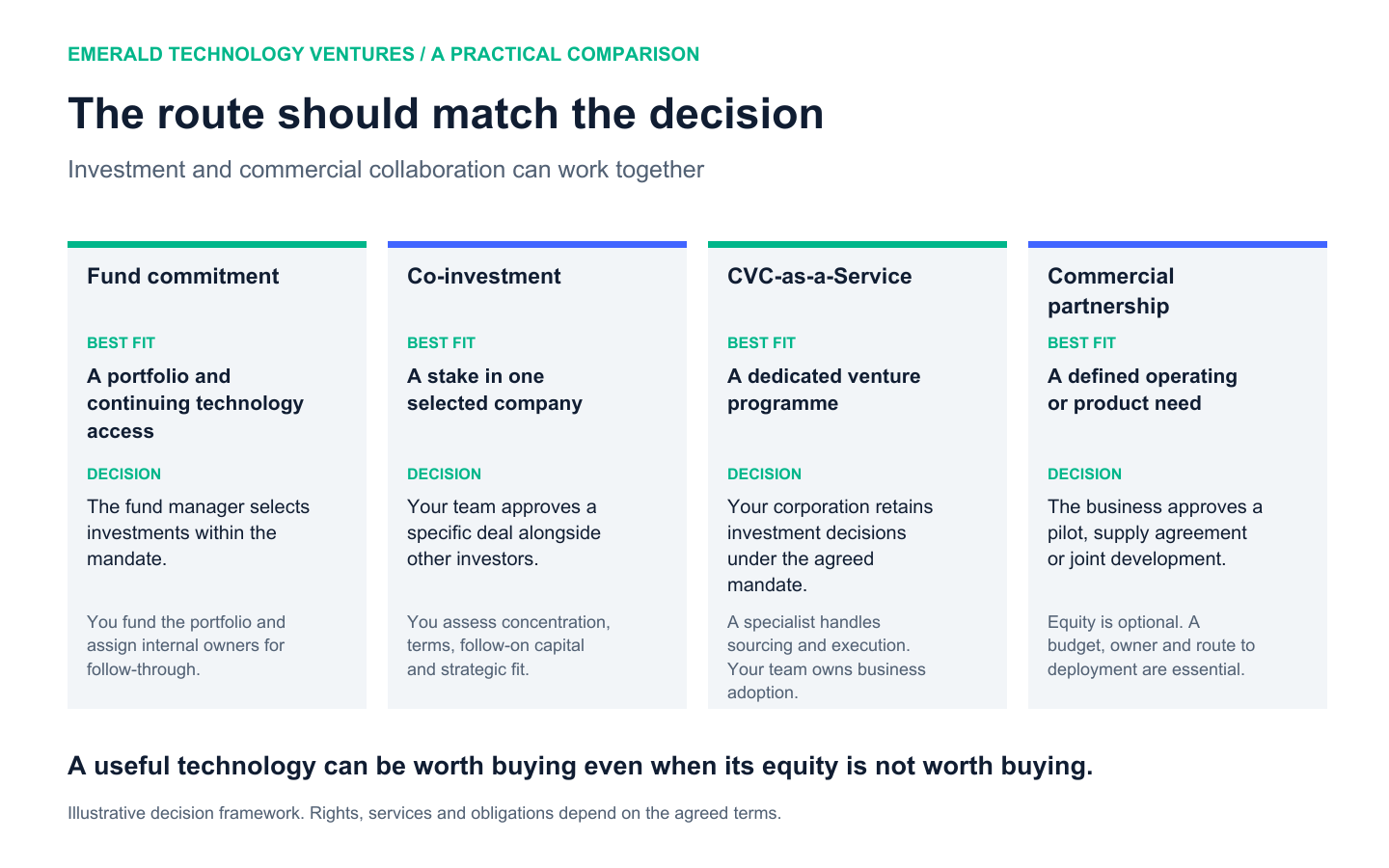
These routes can reinforce one another. A manufacturer may use a fund relationship to understand a market, run a pilot with a relevant start-up and later consider co-investment. None of those steps automatically requires the next. A useful supplier can be a poor equity investment at the wrong price.
How do you identify an emerging technology leader?
1. Start with a problem that has an owner
Replace “find us interesting AI companies” with a measurable brief: reduce inspection errors on a particular line, cut energy use per unit, improve cold-chain reliability or remove a logistics bottleneck. Name the business sponsor, the baseline performance, the operating constraints and the person who could authorize a rollout.
Include the plant team early. Procurement, IT, operational technology, safety and legal colleagues can identify requirements that would otherwise surface after an enthusiastic pilot.
2. Compare a global field of solutions
Assess several approaches to the same problem, including established suppliers and internal development. A specialist investor can widen that comparison through sector knowledge, company relationships and due diligence. Ask what was rejected and why, as well as what made the shortlist.
Geography matters. In 2025, industrial robot installations grew 20% in China and 12% in the United States, while falling 19% in Japan and 8% in Germany, according to the International Federation of Robotics. These are adoption figures, rather than a ranking of start-up quality, but they show why a global perspective is useful. [1]
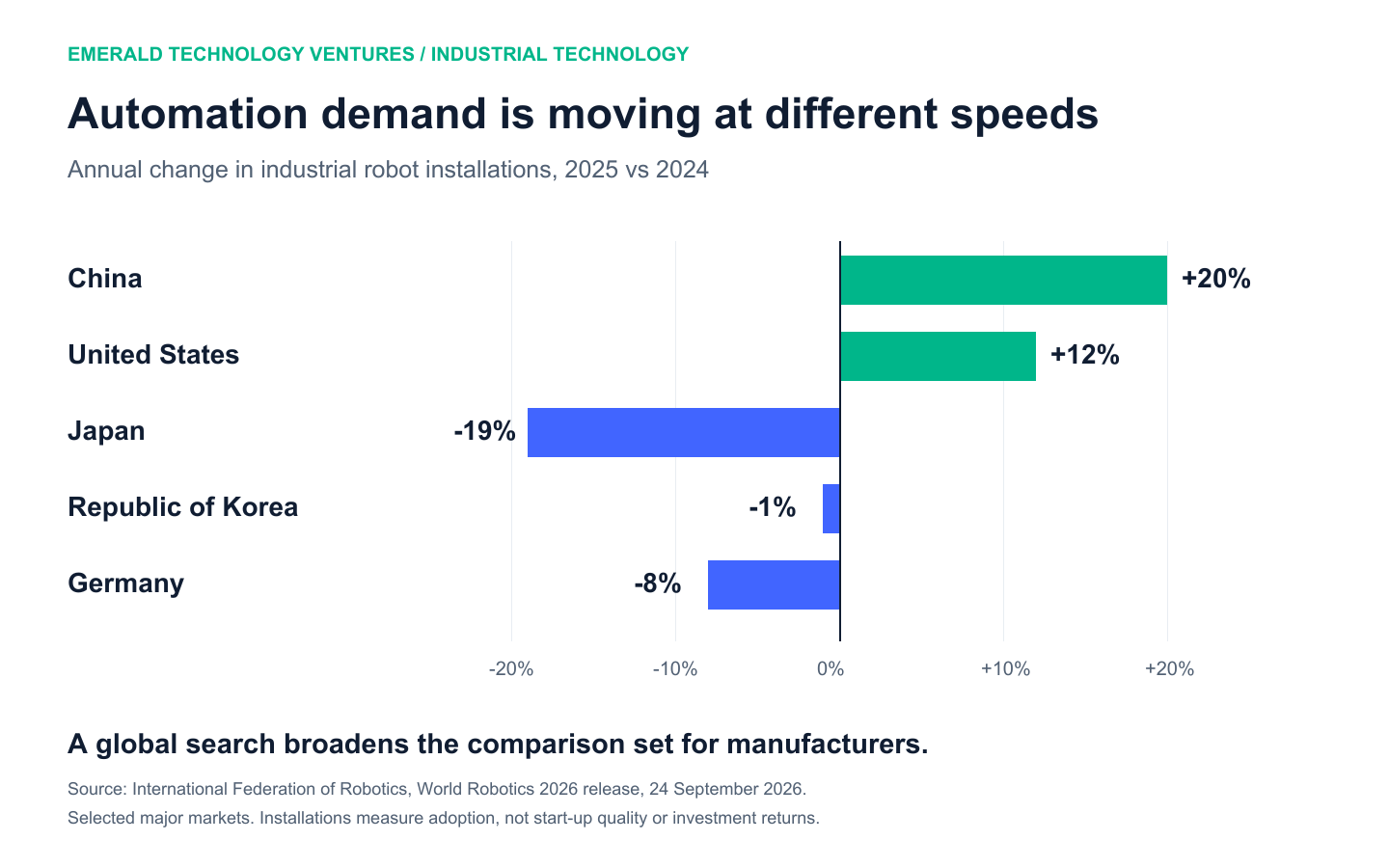
Figure 1. Demand differs across major automation markets. A global search helps manufacturers compare a wider field of technologies.
3. Ask for evidence from the operating environment
A promising industrial technology leader should be able to explain where its solution works, where it fails and what it costs to deploy. Use five tests:
Technical performance: independently check the core claims and test against realistic production conditions, including failure and recovery.
Customer evidence: speak with users about paid deployments, repeat purchases, uptime, support and the effort required from their own teams.
Economics: calculate total deployment cost, including integration, training, maintenance and downtime. Compare benefits with the current process.
Defensibility: examine intellectual property, specialist know-how, data rights and the difficulty of replicating the solution.
Ability to scale: assess cash runway, manufacturing capacity, supply dependencies and service coverage across your intended markets.
A supplier evaluation and an equity investment review overlap, but they answer different questions. Investing also requires scrutiny of valuation, ownership dilution, investor rights, follow-on financing and plausible exit routes.
4. Make the pilot answer a rollout decision
Before a pilot starts, agree the conditions for expanding, redesigning or stopping it. Record who owns the decision, the budget and the timetable. Settle data use, intellectual property and support responsibilities. A successful pilot with no rollout owner is an unfinished project.
What does this look like in Emerald’s work?
Embotech: evidence beyond the demonstration
- Emerald and Yttrium co-led Embotech’s CHF 23.5 million Series B, with participation from BMW i Ventures and Nabtesco Technology Ventures, among others. Emerald also sourced the opportunity for Nabtesco under its CVC-as-a-Service mandate. [2]
In its release dated 27 October 2026, Embotech reports one million automated vehicle movements across four BMW Group production sites in Germany and the UK. The system handles approximately 3,500 movements daily, with more than 99.5% availability. The first 500,000 movements took 15 months; the next 500,000 took seven. [3]
For a manufacturer evaluating automation, those measures help frame the right questions about repeatability, operating reliability and expansion across sites. They do not establish the investment return or replace an assessment of the buyer’s own environment.

Figure 2. Embotech reports a shorter interval for the second block of 500,000 movements. The operating footprint evolved, so this is not a controlled productivity comparison.
SCG and Phase Change Solutions: co-investment with a product purpose
Emerald’s work with SCG included mapping thermal-management start-ups, due diligence and transaction structuring. SCG co-invested with Emerald in Phase Change Solutions, followed by joint product development. [4]
That relationship has a concrete industrial expression. In 2024, SCG Chemicals described how its subsidiary Texplore and Phase Change Solutions developed thermal-management materials for cold storage in Thailand, combining by-products from SCGC’s polyolefin production with PCS’s engineered-materials technology. [5]
The lesson is to define what each side brings beyond capital: materials expertise, a product-development team, manufacturing capabilities or access to customers. Those contributions need a commercial work plan of their own.
Nabtesco and DeepSea: a route to a strategic acquisition
Emerald supported Nabtesco’s initial investment in maritime AI company DeepSea in 2021 and facilitated Nabtesco’s acquisition of the business in 2023. The combination connected DeepSea’s vessel and voyage optimisation software with Nabtesco’s marine ambitions. [6]
For industrial groups, venture investment can create time to understand an adjacent capability before considering an acquisition. An acquisition remains a separate decision, and a fund relationship or minority stake does not automatically provide control or preferential purchase rights.
What should manufacturers look for in an industrial innovation fund?
Start with technical depth and evidence of useful corporate relationships. Ask who will evaluate the technologies, how competitors are benchmarked and how the manager helps companies move from introductions to commercial work. Request references from both corporate investors and founders.
Emerald’s Industrial Innovation Fund sits within a broader specialist platform spanning industrial technologies. Its corporate offering combines investment exposure with sector expertise and access to opportunities. Innspire, Emerald’s investor platform, supports deal-flow review, company evaluations and tracking against investor KPIs. Its Sprints help companies define priorities, identify relevant start-ups and develop collaboration plans. These mechanisms make the relationship useful between financing rounds. [7–9]
Then examine alignment. Review fees, investment duration, co-investment allocation, confidentiality, potential conflicts and the services actually included. Emerald’s flex-term structure supports continuing participation, with a minimum investment period described as five years. Ending an active investment period should not be confused with immediate access to cash from illiquid holdings. [10]
Venture investments can lose all their value. A fund diversifies exposure across companies but retains technology and market risk. A direct co-investment increases exposure to one company, potentially on top of an indirect holding through the fund. Strategic relevance should strengthen investment discipline.
How can a manufacturer get started in 90 days?
Use the first 90 days to establish a decision process. Some technologies will require much longer testing and qualification.
Days 1–30: choose two or three business priorities, establish baseline measures and assign executive and operating sponsors. Separate the investment budget from the pilot budget.
Days 31–60: compare technology approaches and potential venture partners. Review customer references, integration requirements and the commercial case. Identify the evidence still missing.
Days 61–90: approve the appropriate next step: a pilot, a fund commitment, direct investment diligence or a decision to stop. Give each action an owner and a review date.
Track two sets of results separately. Financial measures include capital invested, distributions and the remaining portfolio’s reported value. Operating measures include qualified opportunities, paid deployments, expansion to additional sites and verified changes in cost, quality or output. Introductions and pilot counts describe activity; operating results show whether that activity helped.
Frequently asked questions
Does a manufacturer need its own corporate venture capital team?
It needs internal accountability, but it does not always need a full investment organization. A specialist fund or CVC-as-a-Service provider can support sourcing and investment work. The manufacturer still needs people who connect those opportunities to business decisions.
Is co-investment less risky than investing alone?
An experienced partner can contribute diligence, governance and sector knowledge. The investment still carries company-specific risk. Co-investors must assess the opportunity and their own exposure, including any overlap with existing fund holdings.
Must a manufacturer invest before working with a start-up?
No. Pilots, purchasing, licensing and joint development can proceed without equity ownership. Investment makes sense when the financial case and strategic rationale justify the additional commitment.
How can Emerald help manufacturers find relevant technologies?
Emerald combines specialist investment teams, industrial innovation funds, its Innspire investor platform, corporate venture mandates and focused Sprints. The appropriate combination depends on whether the manufacturer needs continuing market insight, a specific technology partnership or direct investment support. [7–9]
The useful next step is a clear brief: which operating problem or future capability matters, what evidence would justify action, and who will act on it? That gives a venture partner something precise to work with, and the manufacturer a basis for judging whether the relationship delivers.
Sources
1. International Federation of Robotics, World Robotics 2026 release, 24 September 2026.
2. Emerald, “Emerald leads CHF 23.5 M investment in Embotech, autonomous driving innovator”.
4. Emerald, CVC Case Studies, SCG / Phase Change Solutions case.
6. Emerald, “Emerald buoys AI-enabled shipping as partner Nabtesco acquires DeepSea”.
7. Emerald, corporate investor offering and CVC-as-a-Service.
8. Emerald, Innspire investor platform.
10. Emerald, “The big flex: breaking a sacred rule of venture capital”.