


Japan has no shortage of robots or reasons to need them. An ageing population and a shrinking workforce are turning automation from an industrial ambition into an economic necessity.
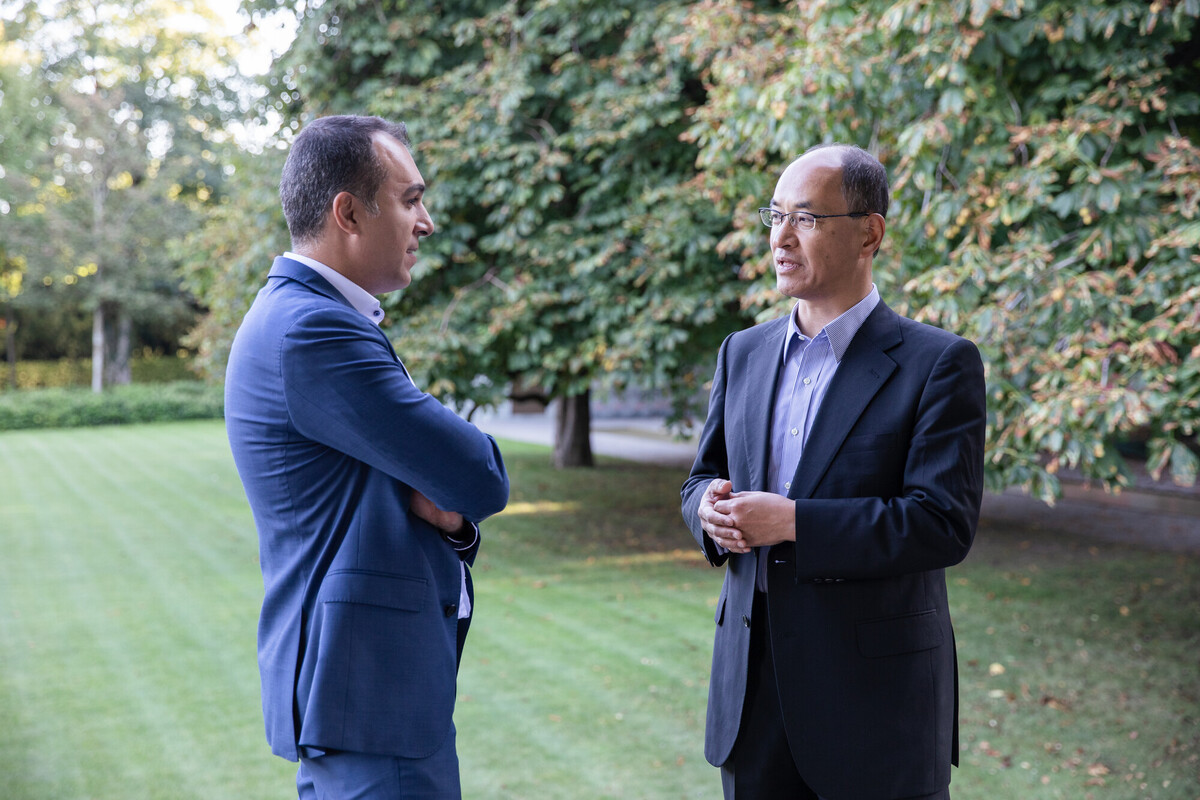
Against this backdrop, Nabtesco Technology Ventures (NTV) has invested in LOMBY, a Tokyo-based developer of autonomous robots for last-mile delivery and factory logistics. The deal, NTV’s third investment in a Japanese start-up, prompted Mehran Zaker, a Partner at Emerald, to sit down with Hiroshi Nerima, NTV’s Managing Partner, to discuss Japan’s increasingly selective venture market, what LOMBY could mean for Nabtesco and why successful corporate venturing requires rather more than a cheque and an appetite for innovation.
Mehran Zaker: How would you describe the state of Japan’s start-up and venture-capital market today?
Hiroshi Nerima: There are two things happening at once. Japan’s start-up ecosystem is clearly more mature than it was a decade ago. There are more experienced founders, more ambitious technologies and more investors who understand what building a start-up involves. But capital has also become more selective. An interesting technology or successful pilot is no longer enough. Investors want to see how a company will build a repeatable business.
I do not think this is necessarily a bad development. Greater discipline can produce stronger companies. The risk is that good technologies are starved of capital before they have had enough time to prove themselves, particularly in robotics and deep tech, where progress does not fit neatly into a software-style growth curve.
Corporate investors can help here, because they can offer something besides money: customers, manufacturing expertise, operating environments and patience. But that only works if they remain engaged after the investment.
Mehran Zaker: The Japanese government has invested heavily in building its start-up ecosystem. Where has the greatest progress been made, and what is still missing?
Hiroshi Nerima: Japan has become much better at creating start-ups. Universities are producing more spin-outs, founders have access to more support, and entrepreneurship is increasingly seen as a serious career rather than an eccentric choice.
Where we are still less successful is in helping those companies become large. There is a gap between funding research and building a commercially significant business. Growth capital is part of the problem, but customers matter just as much. A start-up cannot scale on grants and pilot projects indefinitely. At some point, somebody has to buy the product, deploy it and depend on it.
That is why the government’s growing emphasis on procurement and implementation is encouraging. Japan does not lack good technology. The harder question is whether our institutions and corporations can adopt it quickly enough.
Mehran Zaker: What makes Japan particularly interesting for investors in robotics and physical AI?
Hiroshi Nerima: Japan has a habit of encountering the future early, although not always by choice. Our population is ageing, the workforce is shrinking, and many industries are struggling to find people for essential but repetitive work. Automation is therefore not an abstract discussion here. It is becoming necessary to keep parts of the economy functioning.
At the same time, Japan has deep capabilities in engineering, components, manufacturing quality and motion control. Physical AI brings those strengths together with software and autonomous systems.
What interests me is not a robot performing well in a controlled demonstration. The real test comes when it encounters rain, uneven ground, pedestrians, a crowded factory or a customer who expects it to work every day. Japan is a demanding environment in which to prove these systems. If a company can succeed here, the lessons may travel well as other countries begin to face similar demographic pressures.
Mehran Zaker: What made LOMBY stand out from other autonomous-mobility companies?
Hiroshi Nerima: What impressed us was not simply the robot. Many companies can demonstrate an autonomous machine moving from one point to another. The much harder task is making it useful in everyday life.
LOMBY has been building around the realities of operating in Japan: narrow and irregular pavements, local regulation, remote supervision, charging, store operations and the expectations of established companies whose reputations are involved. Its work with Seven-Eleven Japan and Suzuki suggests that the team understands that deployment is as much an organisational challenge as a technical one.
The company is now approaching an important transition. It has shown that the technology can operate. The next question is whether it can run larger fleets reliably and economically. That is the point at which the opportunity becomes more interesting, but also more demanding.
Mehran Zaker: This is NTV’s third investment in a Japanese start-up. Does that indicate a change in the geographical emphasis of the fund?
Hiroshi Nerima: I would not read too much into the number. NTV was established as a global investor, and we will continue to look for the strongest technologies wherever they are being developed.
Nevertheless, investing in Japanese start-ups is meaningful. Nabtesco’s business units can engage closely, and we can bring domestic industrial relationships together with technologies and perspectives from our international network.
There is sometimes an assumption that Japanese corporations must look overseas to find disruptive innovation. The more interesting reality is that Japan is also producing companies around problems it understands unusually well. LOMBY is one example. Its initial market is Japanese, but the demographic and logistical pressures it addresses are not uniquely Japanese.
Our responsibility is to assess these companies against global competitors. Being local should provide access and insight, not a lower investment standard.
Mehran Zaker: What does the LOMBY investment mean strategically for Nabtesco?
Hiroshi Nerima: We are not trying to turn Nabtesco into a last-mile delivery company. That would be the wrong lesson to take from this investment.
The broader opportunity is in the infrastructure that allows service robots to operate continuously and at scale. Nabtesco has already helped connect LOMBY with WiBotic, a US company providing wireless-charging systems for robots. Charging may sound like a small part of the system, but once a company operates a fleet, every manual intervention becomes a cost and a potential source of disruption.
LOMBY gives us a real operating environment in which to understand these requirements. If the collaboration succeeds, the relevance could extend beyond delivery to factory logistics and other service-robot applications. For Nabtesco, this is a practical way of exploring how our motion-control expertise can evolve into smarter and more integrated systems.
Mehran Zaker: What will determine whether LOMBY succeeds commercially?
Hiroshi Nerima: It is important not to romanticise the challenge. The technology is promising, but LOMBY is still at an early commercial stage. A good robot does not automatically create a good business.
The decisive questions will concern utilisation, remote supervision, charging, maintenance and integration into customers’ daily operations. The company must show that deploying more robots improves the economics rather than simply adding complexity and cost.
Concentrating fleets in particular neighbourhoods could improve delivery density. Factory logistics may offer another attractive path because the environment is more controlled and the labour-saving benefit is easier to measure. But both cases have to be proven through repeated commercial deployments.
For me, success is not the number of pilot announcements. It is reaching the point where a customer chooses to deploy more robots because the first deployment genuinely worked.
Mehran Zaker: How does the partnership with Emerald enable NTV to identify and execute investments such as this one?
Hiroshi Nerima: No corporation should assume that industrial expertise automatically makes it a good venture investor. They are different disciplines.
Nabtesco understands its technologies, customers and strategic needs. Emerald brings the experience of seeing many companies, markets and investment outcomes. Its team helps us search more widely, compare opportunities internationally and recognise patterns that would be difficult to see from inside one corporation.
The division of responsibilities is also important. Nabtesco decides where it wants to build strategic capabilities and retains the investment decision. Emerald provides the sourcing, analysis, transaction experience and independent challenge around that decision.
That independence matters to me. A corporate team can understandably become excited about a technology that fits an immediate business need. Emerald helps us ask the less comfortable questions as well: Is this a good company? Is the valuation reasonable? Can it finance its growth? What happens if the collaboration develops more slowly than expected?
Mehran Zaker: LOMBY already had a commercial connection to the Nabtesco Group through WiBotic. What did Emerald add in this particular investment?
Hiroshi Nerima: This is where Emerald was especially useful. A promising collaboration can make a company look attractive, but strategic enthusiasm is not a substitute for investment analysis.
Emerald helped us step back from the immediate relationship and examine the complete company. The team tested the market assumptions, benchmarked LOMBY against international competitors and looked closely at what would have to happen for fleet operations to become economically sustainable. It also considered future financing needs, potential exit routes and what a sensible level of exposure would be at this stage.
That process did not remove the uncertainty; venture investment never works that way. What it did was make the uncertainty more visible and manageable. We could then decide whether the strategic opportunity and potential return justified taking those risks.
Good advice is not advice that confirms what you already want to believe. It is advice that improves the quality of the decision.
Mehran Zaker: What advice would you give other Japanese corporations considering start-up investment?
Hiroshi Nerima: I would not begin by asking, “Which technologies should we invest in?” I would begin with a more uncomfortable question: “What does our company need to do in the future that it cannot do alone?”
That creates a much clearer basis for working with start-ups. The corporation should also be honest about what it can contribute. Capital is useful, but founders will usually benefit more from access to customers, technical expertise, production capabilities or international markets.
Internal ownership is essential. If no business unit is willing to spend time with the start-up, the investment is unlikely to achieve much strategically. At the same time, the corporation has to respect the company’s independence. A start-up cannot become an outsourced research department serving one shareholder.
Finally, speed matters. Start-ups cannot wait indefinitely for every internal stakeholder to become comfortable. Corporate venture investment requires sound governance, but it also requires the courage to make decisions before every uncertainty has disappeared.
Mehran Zaker: What would you like this investment to represent five years from now?
Hiroshi Nerima: I hope the robots have become rather unremarkable.
By that I mean people are no longer stopping to photograph them because they are novel. They are simply part of the infrastructure—delivering groceries, moving materials around factories or performing other useful tasks reliably enough that customers barely think about the technology.
For LOMBY, that would mean progressing from promising deployments to a commercially sustainable platform. For Nabtesco, it would mean that our technologies helped make that scale possible and that we developed a stronger position in service-robot infrastructure.
More broadly, I would like this investment to show what can happen when a Japanese industrial company, an ambitious start-up and an experienced venture partner each bring something different to the table. Japan has no shortage of technical ingenuity. The task is to give it a credible route into the world.
Read more: LOMBY press release
----
More on Emerald in Japan:
Emerald scores exclusive investment mandate with Japan’s Idemitsu
Emerald and DIC Partner via $62M Investment Platform to Accelerate Innovation in Physical AI