


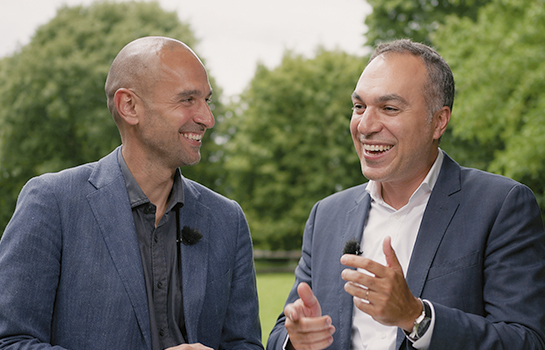
Chemistry and materials science are entering a new era—one where AI can propose novel molecular structures, robots can synthesize them autonomously, and quantum computers loom on the horizon promising to redefine how we solve scientific problems. Few people sit closer to this frontier than Teodoro Laino, Distinguished Research Scientist at IBM Research in Zurich.
In this conversation, Emerald’s Mehran Zaker sits down with Teodoro to explore the shifting landscape of computational chemistry, the evolution from large general-purpose AI models to smaller specialized ones, and how the merger of AI, robotics, and quantum computing could transform R&D in the coming decade.
The Early Days: Joining IBM and Staying for 17 Years
Mehran: You started at IBM Research in Zurich 17 years ago. How did you get here, and what kept you so long?
Teodoro: I joined IBM in 2006, right after university. I have a background in theoretical chemistry, and I’d always worked closely with computers. IBM felt like the “cool place to be” at the time, so I applied...and got lucky.
My first chapter at IBM was all about mainframes, scientific software, and optimizing computational performance for calculations on materials and molecules. But what kept me here all these years is simple: I get bored easily and IBM has been one of the few places where you can continually reinvent yourself. The research environment changes constantly, and there’s always a new frontier to explore.
AI and the Materials Revolution
Mehran: Over the past decade, your work has focused on computational chemistry and, more recently, AI for material and molecule discovery. How is AI changing the materials industry?
Teodoro: Chemistry and materials science have been fertile ground for AI from very early on. Back in 2017, when the first seeds of large language models appeared, our group was one of the pioneers applying them specifically to chemistry and materials.
Chemistry is, fundamentally, a data-driven science. We’ve been collecting experimental data for 200–300 years. That’s a treasure trove for training digital versions of top chemists.
But the revolution is still incomplete. We’ve shown repeatedly that AI can dramatically accelerate discovery, but the bottleneck now is data quality. To reach business-grade performance, we need more standardized, structured, high-quality chemical data. Despite the abundance of data available, gaps remain.
Still, I’m a strong believer that AI will be deeply embedded in R&D—and even in production—within the next five to ten years.

Why Smaller, Specialized AI Models Beat Large General Ones
Mehran: You’ve mentioned previously that we’re moving from large general-purpose LLMs to smaller, specialized models. What does that mean in your field?
Teodoro: Yes, this is a big shift. It’s becoming clear that one model cannot do everything well.
Specialized models are:
- Cheaper
- More sustainable
- More accurate
- Less prone to hallucinations
Let me illustrate. Ask a general LLM a high-school chemistry question, and it’ll give you a great answer. But ask a question that only a PhD working in natural product synthesis would know, and it may still sound impressive, but it will fall apart under expert scrutiny.
Generalist models produce statistically plausible answers. But when the underlying data is sparse—what I call “statistical pressure”—you get hallucinations.
If you instead train a model exclusively on chemistry, you reduce that risk dramatically. It won’t write Shakespearean poetry, but it will understand molecules far better.
This approach gives you a model that is more accurate, more sustainable, and more cost-effective—all at once. It’s rare in technology that these three benefits align, but here they do.
From Molecules to Robotics: The RXN Project
Mehran: I’d love to talk about the RXN project—your work combining AI with robotics to actually synthesize molecules. How do you see AI merging with the physical world more broadly?
Teodoro: I’m glad you brought that up. One of the greatest potentials of AI is eliminating the repetitive tasks that experts spend too much time on—tasks that are not intellectually rewarding.
The RXN project is a great example. Although it was used for drug discovery, the bigger message was demonstrating—back in 2019—that a fully autonomous lab is possible. At the time, many scientists doubted it.
But the hardware already existed commercially. This wasn’t a scientific problem—it was an engineering one.
I added the idea into our annual strategy deck almost as a “let’s see what they say” proposal. To my surprise, the director loved it and asked, “How much do you need?” The budget was small, he approved it immediately, and nine months later:
- we had a domain-specific chemistry LLM,
- connected to a robotic system,
- capable of synthesizing molecules autonomously.
We even showcased it live at the shore of Lake Zurich with about 100 people watching, running a synthesis remotely from the lab.
Of course, going from demonstration to business impact takes time—derisking, ROI calculations, scaling considerations. But I strongly believe the chemical industry will move in this direction. Robotics takes over the tedious parts; AI catches unexpected events in real-time and adjusts the synthesis pathway.

The Next Frontier: Combining AI and Quantum Computing
Mehran: As an engineer, I’m sure you’re already thinking beyond today’s AI. What excites you most over the next 2–5 years?
Teodoro: This is what I’m most passionate about. My background is in quantum mechanics, and I started my career in high-performance computing. The next frontier is combining AI and quantum computing.
We now have a clear roadmap for quantum scalability. By 2029, we expect quantum computers capable of solving real-world problems. So the challenge from 2025 to 2029 is developing the algorithms that will run on them—especially algorithms where AI and quantum work together.
Some concrete problems?
- Optimization
Almost everything around us is an optimization problem:
- Logistics
- Supply chains
- Portfolio management
- Routing
- Resource allocation
We still rely on algorithms invented 40–60 years ago. Quantum + AI could give us drastically faster and better solutions.
- Predictive modeling for physics
Weather forecasting, aerodynamic design, and many engineering tasks are based on fundamental equations we solve using approximations on classical machines. Quantum approaches could dramatically improve their accuracy.
That’s the direction we’re doubling down on for the next 3–4 years.
Conclusion: A New Scientific Era Is Coming Into View
Teodoro’s work offers a rare glimpse into how dramatically—and how quickly—the world of chemistry is changing. What began with computational models and lab-scale experimentation is now accelerating through three converging forces: domain-specific AI, autonomous robotics, and the rise of quantum computing.
His story underscores a larger shift taking place across scientific industries. Instead of relying on decades-old algorithms or manual lab work, researchers are beginning to collaborate with intelligent systems that can design molecules, run experiments, optimize processes, and even salvage reactions in real time. This partnership between human intuition and machine precision is already reshaping R&D timelines, and Teodoro believes it’s only the beginning.
The next frontier—where AI and quantum computing operate together—may unlock problems previously considered unsolvable, from global supply chain optimization to next-generation climate and materials modeling. And what’s striking about Teodoro’s outlook is not just technological optimism, but a very pragmatic confidence: the hardware, data, and scientific foundations are finally aligning. The roadmap is real.
For anyone watching the evolution of materials, chemicals, or advanced computing, the message is clear: we are entering a phase where discovery becomes faster, more autonomous, and more intelligent than ever before. And as Teodoro suggests, the breakthroughs we’ll see by the end of this decade may redefine not just laboratories—but entire industries.
More on AI, Robotics and Industrial IT at Emerald:
Industrial AI and Robotics Newsletter Sign-up
Doing More with Less: How Corporations Can Sustain Innovation in Lean Times